

The Complete Guide to Eating Oysters: Types, Pairings & More
Did you know every oyster is unique and tastes like the water it grew in? Oyster farmers call this merroir, the marine equivalent of terroir. That’s one of the things I love so much about oysters: there’s always more to learn. Most seafood gets seasoned, sauced, or cooked into something new by the time it reaches you. An oyster is eaten in its purest form, and the flavor shifts with the water, the season, even the specific farm it came from.
If you’re new to oysters, my guide will make you an expert in no time. I’ll cover the different types of oysters, what they taste like, what to pair them with, and more.
What are Oysters?
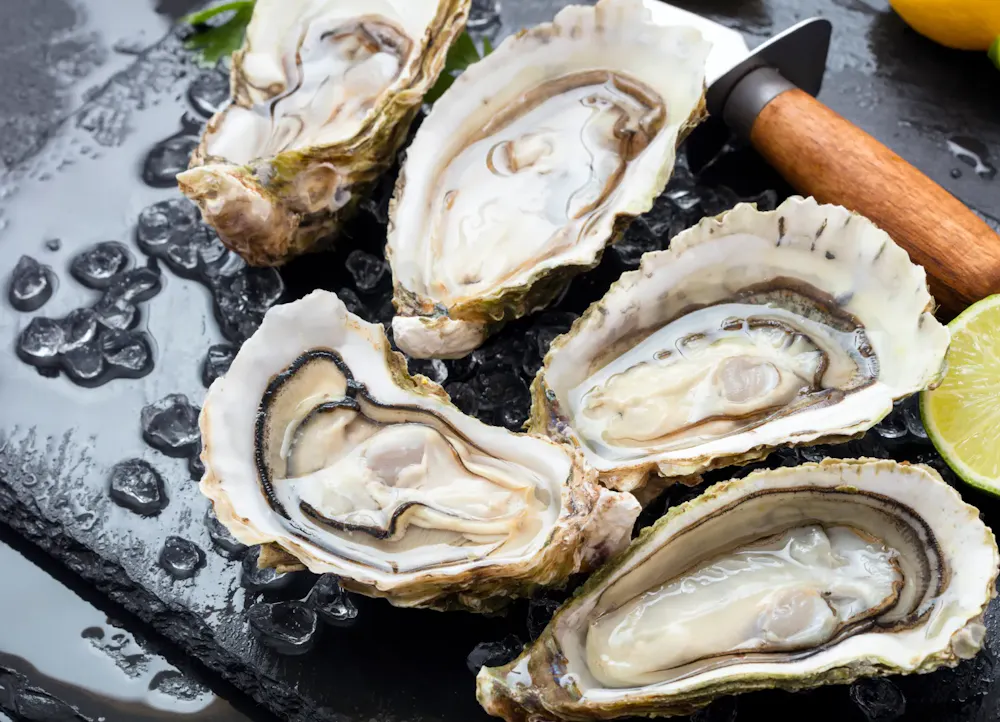
Oysters are bivalve mollusks, the same family as clams and mussels, and they spend their entire adult lives fixed in one spot. They’re usually cemented to a rock, a reef, or often another oyster, forming the dense clusters that make up an oyster bed. They start life drifting as free-swimming larvae for a couple of weeks before settling down permanently, and from that point on, they never move again.
They survive by filtering seawater for plankton and other organic matter, and a single oyster can filter around 50 gallons of water a day. They pull in whatever nutrients happen to be drifting past and push cleaner water back out. You’ve probably heard about oyster reefs and how crucial they are to the health of a bay — now you know why.
The History of Oysters
People have been eating oysters for a long time. Archaeologists have found evidence of shellfish meals dating back more than 100,000 years, and by the time of ancient Greece and Rome, oysters had become a delicacy. The Greeks were also among the first to cultivate them, while the oyster’s reputation as an aphrodisiac grew from the myth of Aphrodite emerging from the sea in an oyster shell.
By the late 1800s, oysters were everywhere. They were so abundant and cheap that street vendors sold them throughout cities like New York and Boston, where they were a working-class staple rather than a special-occasion splurge. Overharvesting, pollution, and disease depleted many wild oyster beds during the following century, pushing prices back up. Today, oyster farming supplies most of the oysters we eat and has helped return them to menus around the world.
What Do Oysters Taste Like?
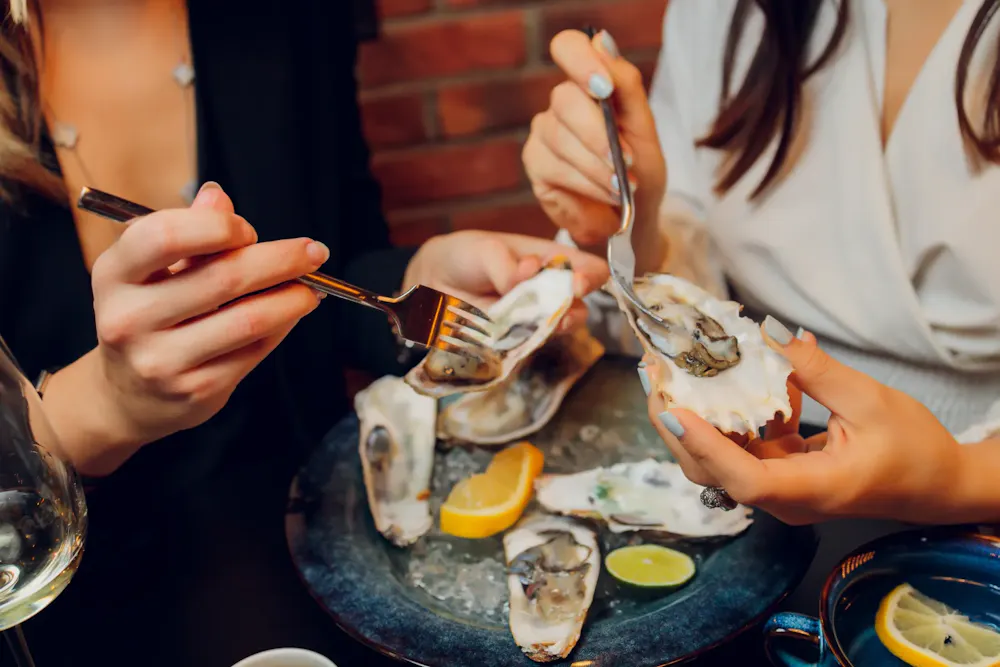
The honest answer is: it depends. Remember that word I mentioned earlier? Merroir is what makes each oyster’s flavor unique. Salinity, water temperature, mineral content, and whatever plankton an oyster happens to be filtering that season all contribute to the flavor.
Cold, salty water tends to produce flavors that are more briny and mineral-like, sharp and salty in a way that reads as pure ocean. Warmer, calmer water produces something sweeter and rounder, closer to melon or butter than brine. Two oysters of the exact same species, raised a few hundred miles apart, can taste like entirely different foods. Similarly, the same oyster bed can shift in flavor from one season to the next, depending on what's been happening in the water.
East Coast vs West Coast Oysters
I’m guessing you’ve seen at least one of these on a menu somewhere, but what exactly is the difference? It may seem like a small difference, but the difference between these two is actually massive.
East Coast oysters are almost all Crassostrea virginica, native to waters running from Canada down through the Gulf of Mexico. The shells are smooth, flatter, and teardrop-shaped. The flavor runs brinier and more mineral, with a touch of seawater, sometimes a faint copper note, and occasionally a faint seaweed or vegetal note underneath. This is the flavor most people picture when they picture an oyster: salty, assertive, and a little sharp around the edges.
West Coast oysters are typically Crassostrea gigas, introduced from Japan in the late 1800s and now the dominant species from California up through British Columbia. The shells are deeply cupped and fluted rather than smooth, almost ruffled. The flavor starts with a lighter salinity and moves into something sweeter with hints of cucumber, melon, and butter on the finish. If East Coast oysters taste like the ocean, West Coast oysters taste like a gentler version of it.
Neither is objectively better than the other (though as a Bostonian, I’m partial to East Coast oysters). It all depends on what you like and what’s available in your region.
Types of Oysters: The 5 Oyster Species & Varieties
To complicate matters even further, there are tons of different types of oysters and varieties. And yes, each one has its own merroir, but they often follow a similar flavor profile based on their location. So let’s get into it.
Crassostrea virginica (Eastern Oyster)
The native East Coast species is farmed and wild-harvested anywhere from Canada down through the Gulf. This species of oyster has smooth, flatter, teardrop-shaped shells and a briny, mineral flavor. A single species, but the water it grows in produces wildly different results. Here are some of the most popular Eastern oyster varieties:
Beausoleil (New Brunswick, Canada) — Small (around 2½ inches) with light salinity and a clean finish. It’s meaty with a shallow cup that makes it easy to shuck. This is a great oyster for beginners.
Wellfleet (Cape Cod, Massachusetts) — This is New England's signature variety (and my personal favorite), coming in around 3½ inches with a moderate cup. Clean and crisp with pronounced brine, plump meat, and a light seaweed flavor.
Blue Point (Long Island, New York) — This one’s usually bold and salty, around 3½ inches with a shallow-to-medium cup. It has a firm, meaty texture with an almost buttery finish.
French Kiss (New Brunswick, Canada) — This Canadian variety is around 3½ inches with a deep cup. It’s full and plump, with strong salinity that settles into a sweet finish.
Crassostrea gigas (Pacific Oyster)
Introduced to the West Coast from Japan in the late 1800s and now the dominant species from California up through British Columbia. It has deeply cupped, fluted shells and a flavor that leans sweeter and milder. Common examples include:
Kusshi (British Columbia) — Small, around 2¼ inches, with a deep cup and unusually smooth shell. Very clean and mild, a popular option for anyone easing into raw oysters.
Fanny Bay (British Columbia) — Approximately 3 inches with a moderate cup. Briny with plump meat and a slightly mineral edge, a solid middle ground if you’re not sure which coast to order from.
Hammersley (Washington State) — This one often grows to 4 inches or more, with a deep cup and substantial, meaty texture. It’s creamy and full-flavored, with subtle salinity and a distinctive cucumber finish.
Shigoku (Washington State) — This one averages 2 to 3 inches, with a deep, smooth, rounded shell. It’s intensely briny with a sweet finish and crisp texture, which makes it another good option for a first-timer.
Crassostrea sikamea (Kumamoto)
Once treated as a small variant of the Pacific oyster, Kumamotos are now recognized as their own species. It’s usually quite petite, rarely more than 2 inches, with an exceptionally deep, fluted cup. The flavor has hints of melon and butter with almost no fishiness at all. It’s sweet and creamy enough to win over your friend who claims they don't like oysters.
Ostrea lurida (Olympia Oyster)
This is the only oyster species native to the West Coast of North America, and they’re found all the way from California to British Columbia. They’re also extremely rare. It’s tiny (under 2 inches and rarely bigger than a quarter) and fragile, but with an outsized, coppery, almost mushroomy intensity that punches well above its size. In fact, James Beard was famously partial to them.
Ostrea edulis (European Flat Oyster/Belon)
Native to France's Belon River and grown in only very limited supply in the U.S., mainly in Maine's Damariscotta River. They’re flat-shelled and foraged in small quantities, often by hand. The flavor is strong and distinctly mineral, so much so that it almost tastes metallic. This one is controversial even among oyster lovers, but worth trying at least once in your life.
How to Eat Oysters
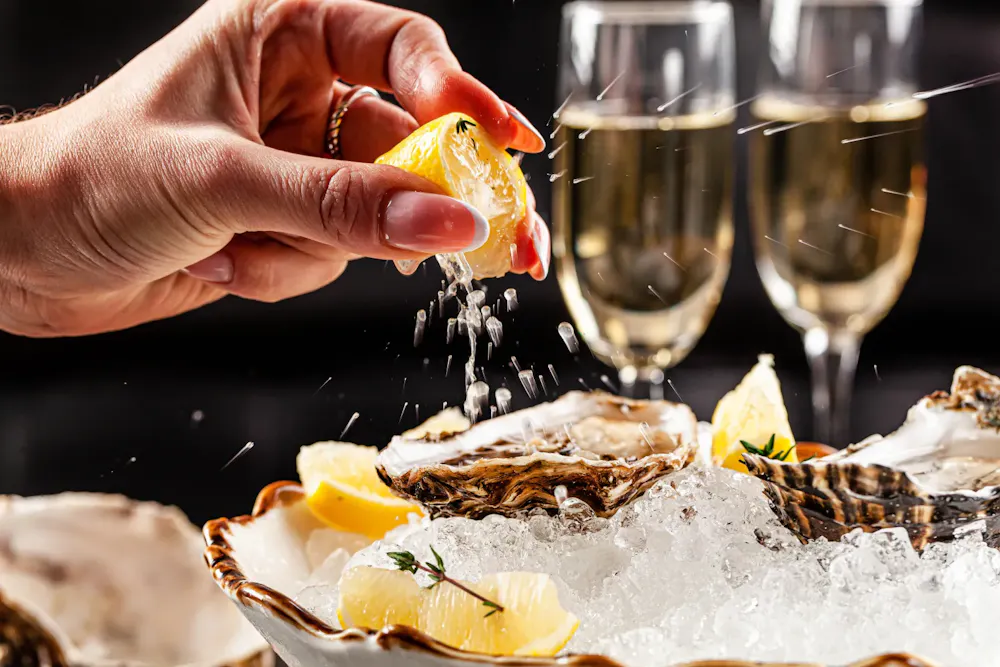
If you’re not sure how to eat raw oysters, trust me — you’re in good company. I get asked this question all the time, and the good news is: it’s really simple! (And also, slurping it out of the shell is pretty fun, too). Here’s what to do.
When the tray arrives, try the first one plain before reaching for mignonette or cocktail sauce. That's the only way to actually taste the merroir. Think of everything else on the tray as seasoning on top of the main event. The liquid sitting in the shell (called the liquor) concentrates the oyster's flavor and salinity, and it's meant to be eaten alongside the meat, not drained off beforehand.
Here’s a big one: chew, don't swallow. A lot of people knock oysters back whole, but that skips most of the flavor and they never get to experience the true taste. Chewing releases the brine and sweetness that distinguish one variety from another.
Once you’ve tried one on its own, try the various goodies the kitchen has sent out. Mignonette (a classic French mix of minced shallot, vinegar, and cracked pepper) is a popular choice, and its acidity cuts through brine without eliminating it entirely. A squeeze of lemon or a light hit of cocktail sauce works too.
Here are some quick tips for etiquette when eating oysters in a restaurant:
A quiet slurp from half-shell oysters is fine. A loud one is not.
Put empty shells back on the tray they arrived on rather than stacking them on the table.
It’s okay to use the small oyster fork to loosen the oyster if needed.
If you’re sharing, take one oyster at a time and give everyone a chance before going back for seconds.
Oyster Pairings: What to Drink with Oysters
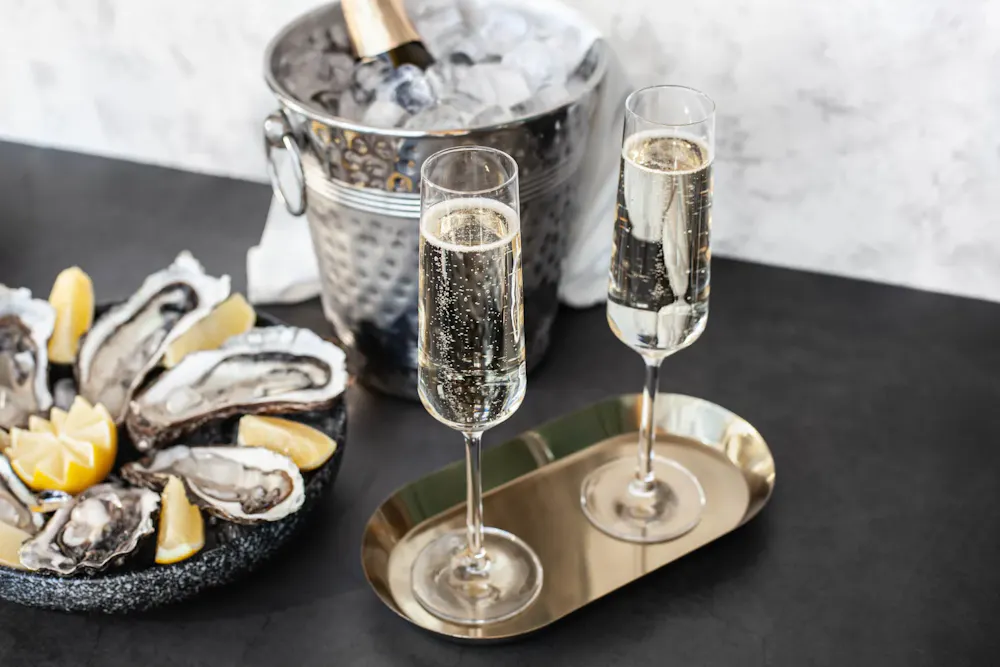
There's a reason certain drinks show up next to oysters again and again. The brine needs something acidic or bubbly to cut through it, or the whole plate starts to taste flat after the third or fourth shell. Here are some of the best drinks to pair with oysters:
Wine & Champagne
The three classic pairings are Champagne, Muscadet, and Chablis. Champagne's fine bubbles and bracing acidity cleanse the palate between oysters while echoing their briny snap. Muscadet, from the western edge of the Loire Valley, is about as close to a "made for oysters" wine as exists. It’s light, mineral, and grown on soil that sits practically on the coastline. Chablis (a chalky, unoaked expression of Chardonnay) brings citrus and minerality from the fossil-rich soil it's grown in.
Beer
The pairing of oysters and beer goes back to 18th- and 19th-century Ireland and the UK, where both beer and oysters were cheap, plentiful staples of coastal taverns. This combo has endured the test of time because, well, it just plain works. A stout's roasted, malty depth and creamy mouthfeel complement the oyster's brine, and the carbonation resets the palate the same way Champagne does. Prefer something lighter? A crisp pilsner or lager is also a great pairing for oysters.
Cocktails
A cold, dry Martini is the raw bar's oldest drink order. It’s clean and briny enough in its own right, particularly with a dirty pour. Vodka on ice or with a splash of soda is also a great alternative if martinis aren’t your thing. If you're feeling adventurous, a well-chosen sake can be a surprisingly smooth combo with oysters.
Experience Oysters at Vermilion
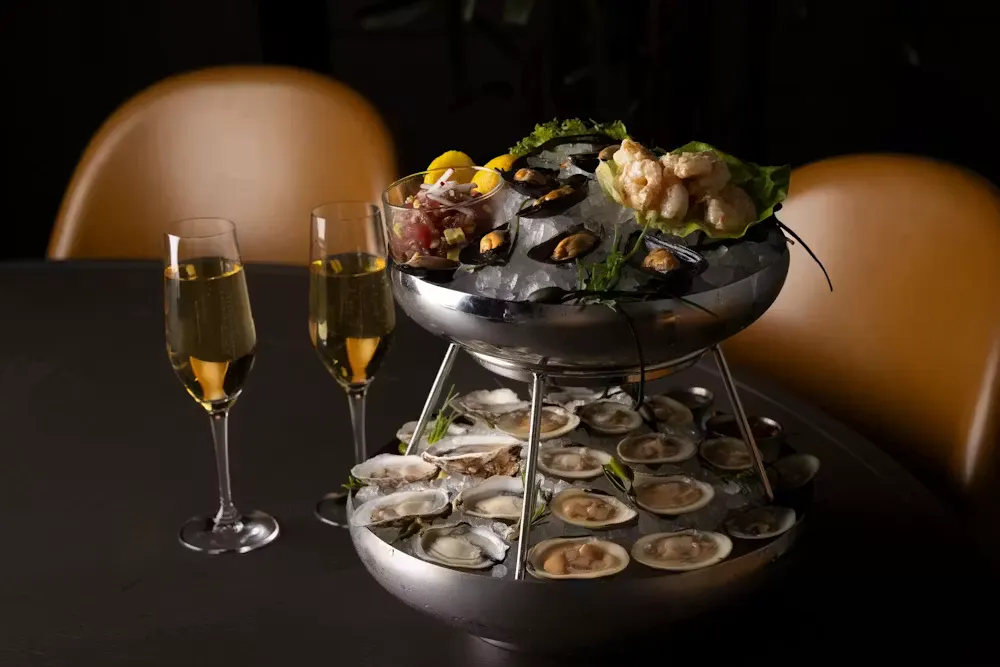
Ready to try the best oysters in Boston? Stop by Vermilion, an iconic steakhouse led by Michelin-acclaimed chef John Fraser. We’re right in the heart of downtown, serving up New England classics like East Coast oysters and Oysters Rockefeller. We’re also the first steakhouse in Boston to offer Prime 850 dry-aged steaks, featuring the top 5% of all USDA Prime beef.
If you're looking for a low-pressure way to try oysters for the first time, join us for $1 oysters during Happy Hour every Monday through Friday. Want the full experience? Book your table and get ready to slurp, sip, and savor your way through the evening.
Oyster FAQs
How many types of oysters are there?
There are five recognized oyster species: Eastern, Pacific, Kumamoto, Olympia, and European Flat. Within those five, there are hundreds of named varieties, each shaped by its specific growing region.
What is the difference between West Coast vs East Coast oysters?
East Coast oysters are almost all Crassostrea virginica, with smooth, flatter shells and a briny, mineral-forward flavor. West Coast oysters are typically Crassostrea gigas, with deeply cupped, fluted shells and a sweeter, milder flavor with notes of cucumber or melon.
When are oysters in season?
Oysters are good to eat year-round. There's an old saying about oyster season and when to eat oysters, claiming you can only eat them in months with an "R". However, that’s a myth that dates back to before reliable refrigeration and no longer applies.
How do you eat oysters?
Here’s how to eat an oyster for the first time: taste the first one plain before adding anything, so you get the actual flavor of the oyster. Sip the liquor along with the meat, chew a couple of times rather than swallowing it whole, and go easy on the mignonette or cocktail sauce.
What are oysters served with?
Mignonette and a squeeze of lemon are classics, along with cocktail sauce for anyone who wants more of a kick. To drink, Champagne, Muscadet, and Chablis are the traditional pairings, though a stout or a cold Martini both work just as well.
Are oysters good for the environment?
Yes. Oysters can filter around 50 gallons of water a day, pulling out excess nutrients and sediment as they feed, improving water quality in a bay. Farmed oysters do that same filtering work while they grow, and unlike a lot of other protein sources, oyster farming requires no feed, fertilizer, or fresh water to produce.